


By Professor Nick Crofts AM
University of Melbourne and the Global Law Enforcement and Public Health Association (GLEPHA)
I have spent thirty years watching a very specific and very painful sequence of events unfold across Southeast Asia. I have watched it happen in Thailand, in Myanmar, in Vietnam, in China – in every country in the region. I have watched governments respond with the best intentions and the worst possible tools. And I have watched communities pay an enormous price that was entirely preventable.
Now, for the first time, I am watching the same sequence begin in the Pacific. And I feel a responsibility to say clearly, and as plainly as I can, what comes next – because Pacific Island nations still have a chance to write a different ending.
The sequence always starts the same way. A drug trafficking route opens. Organised criminal networks – in today’s Pacific, that means cartels from the Americas, outlaw motorcycle gangs out of Australia and New Zealand, and Asian syndicates – find a new corridor. Fiji is already a documented transit hub. Methamphetamine at extraordinary purity and huge quantities is moving through Fiji on yachts from Tonga and elsewhere, narcosubs and flights, bound for consumer markets in the south. The route is not coming. It is already here.
What follows is predictable. As drugs move along a route, some spills into local markets all along the route. Accessibility to the drug increases, prices drop, purity rises, and a new generation of users of the drug evolves – often rapidly. Over time many of the people who use transition from smoking or snorting the drug to injecting – because injecting delivers more effect per dollar. And once injecting takes hold in a community, HIV follows. Not because of anything complicated. Because of a shared needle. These epidemics, based on needle sharing among people who inject drugs, are the most rapid HIV epidemics among any population group – a country can go from having a few people infected with HIV to having thousands in a matter of months.
This is not speculation. It is the documented history of every major HIV epidemic among people who inject drugs across Southeast Asia. The trafficking route opened up from the Golden Triangle. The injecting followed. The HIV epidemic among injecting drug users came next. Many were sexually active, many were sex workers, so HIV spread to their sexual partners. That’s when they started seeing babies born with HIV. By the time governments recognised what was happening, the virus was embedded in networks that were invisible to health systems because the people most at risk had every reason to hide. And the HIV epidemic had become a sexually transmitted epidemic involving people who don’t inject, and their children …
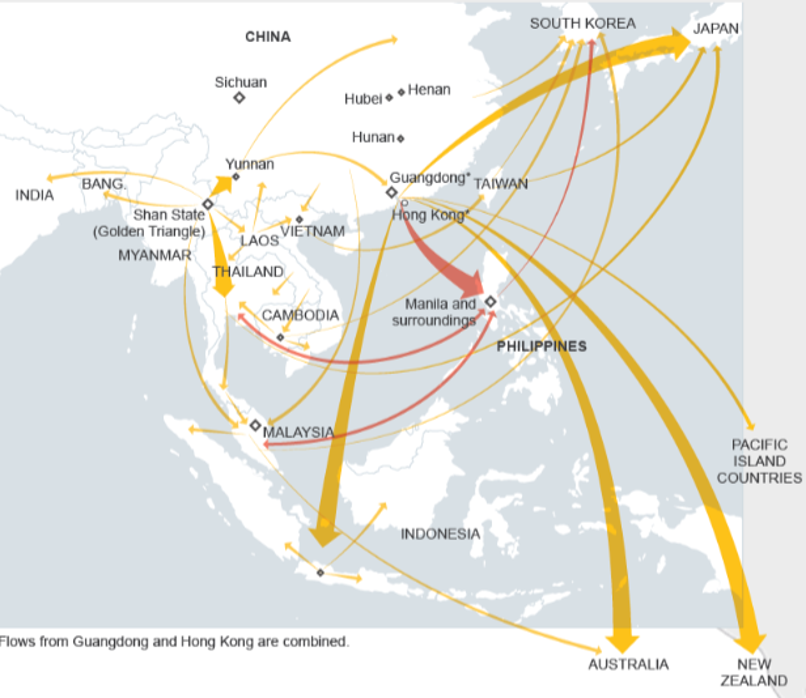
Trafficking Routes from the Golden Triangle
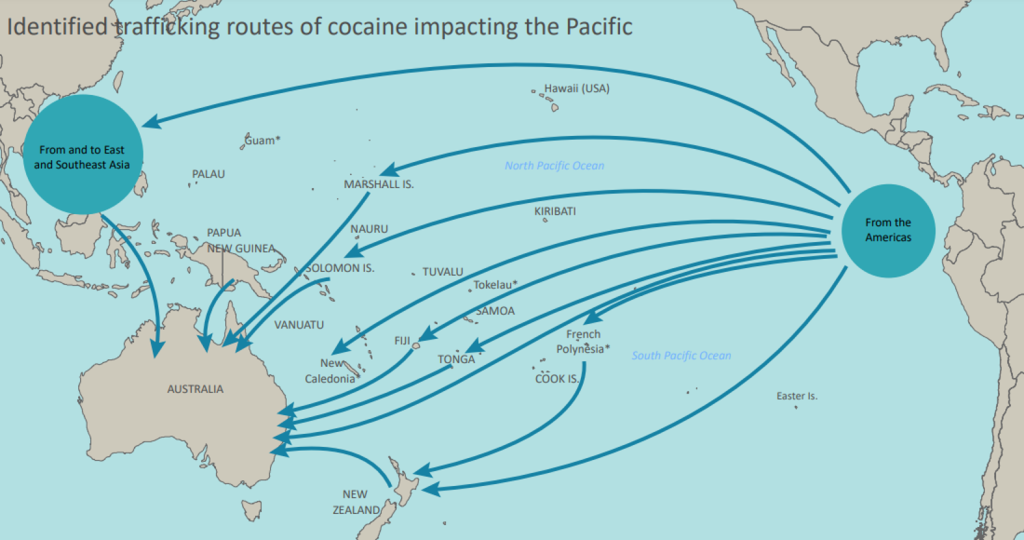
Trafficking Routes across the Pacific
When governments and authorities recognise a new trafficking route opening up, they mobilise law enforcement and security efforts to close it down. The simple effect of this is that the businessmen who run the drug trade find other trafficking routes – and the sequence is repeated. As well, as part of their local War on Drugs, they boost the arrest and imprisonment of drug users, many of whom already have HIV. This creates perfect conditions for spread of HIV inside the prison, where drug use and injecting are common, but needles and syringes are scarce. Inmates living with HIV in prison then go back to their home locale on release, taking the virus with them to a new as yet untouched location. What a magnificent way to ensure that HIV is spread around the whole country! Couldn’t design it better myself.
The Kirby Institute’s rapid assessment, commissioned by the World Health Organization and published late last year under the title The Health Crisis of Our Time, confirmed that Fiji is past the beginning of this sequence. Methamphetamine is being injected. Needles are being shared. New HIV infections are rising sharply. Babies are being born with HIV. The Fiji Ministry of Health has been working urgently to respond. But here is the hard truth that the data also shows: the response is being undermined, in part, by the very people who most want to stop drug-related harm.
When police arrest a person for possessing a needle, that person stops carrying needles. They do not stop injecting. They start sharing. When officers patrol near health clinics, people who inject drugs stop attending. They do not stop injecting. They inject in more dangerous, more hidden places, with more people. Every time a syringe is confiscated, HIV transmission risk goes up, not down.
I am not criticising the police officers who do these things. They are following community desires, instinct, training, and often direct instruction. They believe they are fighting drugs. In a narrow sense, they are. But in an epidemiological sense, they are spreading the virus. The evidence on this is not contested anywhere in the scientific literature. Imprisoning people who use drugs without harm reduction is the single most reliable way to accelerate an HIV epidemic. This has been demonstrated, repeatedly, in country after country. It is not a theory. It is a pattern. It is, in my experience, close to inevitable.
The Pacific’s police leaders know how to follow a pattern.
The question for every Commissioner, every Minister of Police, every senior officer across the Pacific Islands right now is a resource question as much as anything else. Your enforcement capacity is limited. The transnational organised crime networks moving drugs through your maritime corridors are your real threat — to security, to sovereignty, to the social fabric of your communities. If one trafficking route is threatened, there is a plethora of alternative routes across the biggest ocean in the world, and immense amounts of money to fund them. They are the target that justifies your resources. Arresting a person with a syringe does not weaken a cartel. It does not disrupt a trafficking route. It costs you resources, it damages individuals with health and behavioural issues that need health responses, it damages community trust, and it accelerates a public health emergency that will, eventually, consume far more of your capacity than it costs to prevent it now.
The Pacific has something that Southeast Asia did not have when this sequence began there: time, and the knowledge of what is coming.
There are police forces around the world that have already navigated this. One example: the New South Wales Police Force in Australia has operated guidelines protecting needle and syringe programmes since 1988. HIV prevalence among people who inject drugs in New South Wales has remained below one per cent. In countries without those protections, the same figure regularly exceeds fifty per cent. The difference is not biology or culture. It is policy.
The Fiji Police Force, with the support of the Australian Government and our partners at the Kirby Institute, is already beginning this work. Officers are being trained. Protocols are being developed. The foundations of a different approach are being laid. But Fiji cannot do this alone, and the epidemic will not stay within Fiji’s borders.
This is a regional challenge that requires a regional response. The Pacific Transnational Crime Network already exists. The South Pacific Chiefs of Police Conference already meets. The architecture for coordinated action is there. What is needed now is the political will to use it – to agree, across the Pacific, that protecting health-seeking behaviour is not soft on crime. It is smart on crime. It protects communities. It protects officers. And it keeps limited resources focused on the organisations that actually deserve them.
The window is open. Every country in SE Asia that I have watched face this sequence has wished, in hindsight, that someone had come to them at the beginning and said: this is coming, here is what works, and here is what makes it worse. I wish they had listened.
I am saying it now to the Pacific. These HIV epidemics are easy to prevent before they get started; once they are roaring through a community, they are very hard to stop. Those who do not learn from history are destined to repeat it. The lessons are there.
Professor Nick Crofts AM is co-founder and Executive Director of the Global Law Enforcement and Public Health Association (GLEPHA) and a Professorial Fellow at the Nossal Institute, Melbourne School of Population and Global Health for Global Health, University of Melbourne. He has worked on HIV prevention and law enforcement policy in more than thirty countries over three decades.